










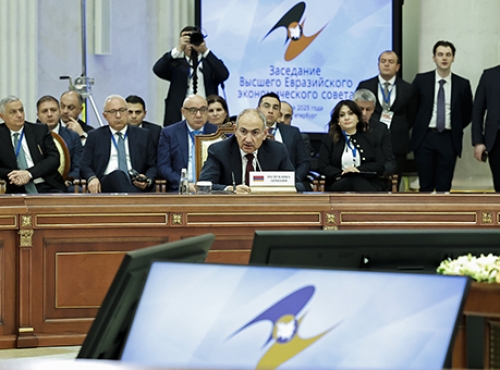
At the Supreme Eurasian Economic Council meeting in St. Petersburg, Armenian Prime Minister Nikol Pashinyan reaffirmed Armenia’s commitment to mutually beneficial cooperation within the framework of the Eurasian Economic Union (EAEU). He stressed the importance of clearly distinguishing between areas governed by supranational mechanisms and those where national sovereignty should prevail.
“This year, we conclude the strategic directions for developing Eurasian economic integration up to 2025, during which we’ve gained significant practical experience. Building on that, we are now shaping the next phase of integration,” he said.
Pashinyan emphasized the need to clearly define the boundaries between areas under supranational mechanisms and those under national jurisdiction to ensure the stability of integration processes.
“This year was crucial for international cooperation within the EAEU. Engagement with key partners like Iran, the United Arab Emirates, Mongolia, China, and India is expanding, opening new markets, diversifying exports and imports, and strengthening the Union’s position in the global economy.”
He welcomed the newly signed free trade agreement with Indonesia.
Pashinyan highlighted ensuring the smooth functioning of the internal market as a top integration priority, involving the elimination of barriers, simplification and digitalization of regulatory procedures, and fair competition.
He noted the growing role of services in EAEU economies, stating that the unified services market improves supplier quality and competitiveness, simplifies processes, and creates a more favorable business climate.
Digitalization, he added, is equally critical, underpinning sustainable development and e-commerce. Improving product traceability and transparency was a key practical focus this year. Developing marking systems and integrating fiscal technologies has enhanced tax administration and reduced shadow turnover.
“These measures help ensure fair competition and protect the internal market while easing the administrative burden on businesses,” he said.
Tourism, he added, has a significant multiplier effect, and the newly adopted tourism development concept would boost mutual tourist flows.
Russian President Vladimir Putin said EAEU cooperation contributes to economic growth and improving living standards across member states. “Our cooperation within the EAEU is progressing successfully and tangibly contributes to economic growth, business income, and most importantly, the quality of life and well-being of our people,” he said.
Belarusian President Alexander Lukashenko noted the Union still has work to do in creating a more comfortable environment for citizens. He cited the absence of border queues, mobile roaming access, and the removal of payment restrictions as key indicators of progress.
“This year, under Belarus’s chairmanship, we sought to enrich our agenda with humanitarian and social priorities. Today, we adopt the tourism development concept. Looking ahead, we propose focusing on healthcare, education, culture, and information exchange,” Lukashenko said.
He concluded that the Union’s strength lies in “simple and tangible benefits” for ordinary people, such as unobstructed access to education, recognition of qualifications, medical services, and the use of familiar payment methods without unjustified limitations.
Although not all goals in Belarus’s presidency were achieved, Lukashenko expressed confidence that its priorities will remain relevant as Kazakhstan assumes the chairmanship.