











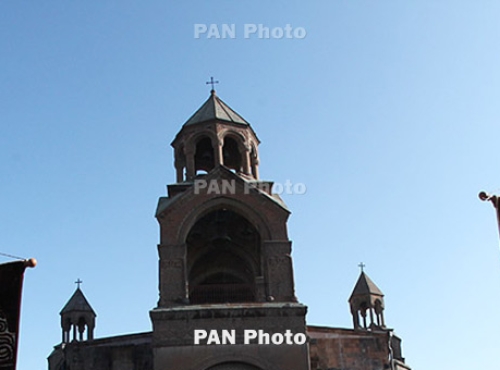
The Lemkin Institute for Genocide Prevention has expressed deep concern over what it describes as continued state pressure on the Armenian Apostolic Church in Armenia. This includes the arrest and intimidation of clergy, targeting of church institutions, and increasing use of legal mechanisms to silence religious leadership, according to Panorama.am .
“These developments pose a serious threat to Armenia’s democratic institutions and represent an assault on foundational pillars of Armenian identity. They are a sobering example of how genocidal processes can embed themselves in collective consciousness during times of vulnerability,” the statement reads.
The tension between the Armenian government and the Church escalated in 2023 after educational reforms removed the “History of the Armenian Church” as a standalone mandatory subject, merging it into broader curricula. Recent state actions against the Armenian Church coincided with a global conference organized by the Mother See of Holy Etchmiadzin in partnership with the World Council of Churches and Swiss Protestant Church, held in Bern from May 26–28, 2025. The conference focused on preserving Armenian cultural heritage in the historically Armenian region of Artsakh, which was invaded and depopulated by Azerbaijan in September 2023.
The event drew criticism from Azerbaijani religious leader Sheikh-ul-Islam Allahshukur Pashazadeh.
While the Armenian government claims its actions are based on criminal evidence, Church leaders condemned the arrests, calling them an attack on religious freedom and a deliberate attempt to weaken the Church.
The statement emphasizes that the Armenian Apostolic Church has long been a spiritual, cultural, and historical cornerstone of the Armenian people. Since Armenia became the first nation to adopt Christianity as a state religion in the 4th century, the Church has safeguarded the Armenian language, culture, and memory through centuries of foreign domination.
“This calculated campaign against Armenian Christianity shows that genocide is not only about physical destruction but also about erasing cultural and spiritual identity. Undermining the Church as a moral compass and unifying institution was central to the genocidal logic. It sought to produce a population severed from its historical memory, sacred geography, and communal bonds. The scars of this destruction remain, as thousands of Armenian religious monuments continue to lie in ruins or under threat in Turkey and Azerbaijan,” the institute said.
The institute warned that while today’s circumstances differ from the genocidal violence of 1915, parallels in logic and methods must be acknowledged. Early signs of identity-based repression often begin with efforts to delegitimize and criminalize institutions that embody collective memory and moral resistance.
The Lemkin Institute called on the Armenian government to immediately cease politically motivated actions against clergy and reaffirm its constitutional commitment to religious freedom and pluralism.
It also urged international observers and human rights organizations to closely monitor developments in Armenia, warning that historically, attacks on religious institutions have preceded broader campaigns of societal fragmentation and identity erasure.
“The strength of Armenia’s democracy and sovereignty lies not in the suppression of its moral institutions but in their protection,” the statement concluded.
On December 18, ten bishops who had met with Prime Minister Nikol Pashinyan and called for Catholicos Garegin II to step down, issued a statement in Etchmiadzin before quickly dispersing. At the same time, a liturgy was being held inside the Mother Cathedral, with the Catholicos present.
‘Another attempted assault on Holy Etchmiadzin took place today, unfortunately involving some of our own clergy. Yet the faithful children of our Church remain steadfast and fearless. This noise stirred within the Church will never hinder our mission or the bright future we envision for our Church and our country,’ said Catholicos Кarekin II.