


















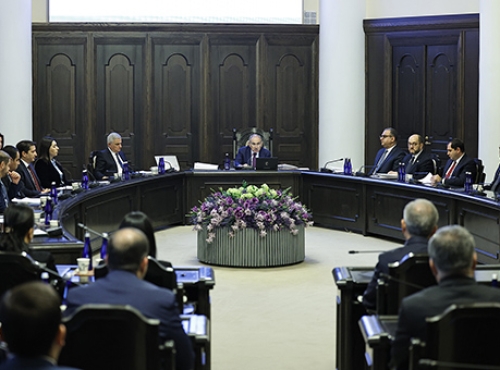
The Armenian government has approved the Doctrine on Economic and Institutional Transformation of Armenia, a 42-page strategic framework designed to guide the country’s development. The document aims to redefine and stabilize both the economy and the structure of state institutions, according to Armenpress.
Presenting the doctrine, Prime Minister Nikol Pashinyan stressed that it goes beyond setting goals and serves as a clear guide for government action.
“This doctrine serves as a roadmap for development, aiming to reassess and strengthen Armenia’s economic structure and state institutions,” Pashinyan stated.
He emphasized that such documents reflect the government’s intentions and direction, showing where the country stands and where it is headed.
Pashinyan underlined the importance of concise, accessible strategic texts that are not time-consuming to read but offer clear policy direction.
The Prime Minister linked the adoption of the doctrine to multiple factors, particularly the over 50% economic growth recorded since the 2018 revolution, noting that GDP per capita has grown 2.4 times during that period.
“We must clearly identify the role of the government in this process. In my view, our primary role since 2018 has been the removal of all restrictions, monopolies, and barriers to economic activity. This has allowed Armenia to maintain macroeconomic stability and achieve remarkable growth, despite global challenges like the pandemic and regional tensions,” he said.
He stressed that the growth is a result of citizens’ efforts, not just the government's, highlighting the role of working, tax-paying individuals in Armenia’s success.
Pashinyan noted that Armenian citizens continue to play a key role in shaping and implementing government strategies, and the doctrine is centered on an educated, capable, and creative citizen as the core of a sovereign and secure economy.
He also tied the doctrine’s adoption to the new security environment emerging from peace with Azerbaijan.
The document highlights digitalization, artificial intelligence, and energy transformation as priority sectors. It also includes the development of a long-term tax policy, with the possibility of a new Tax Code to remain in force for at least ten years.
“The doctrine is not lengthy, but it is comprehensive. It rests on one fundamental idea: the state is a continuous institution. Governments may change, but economic policy must remain stable and predictable. At its core is the belief that the country’s economic development is in itself a matter of national interest,” Pashinyan concluded.