












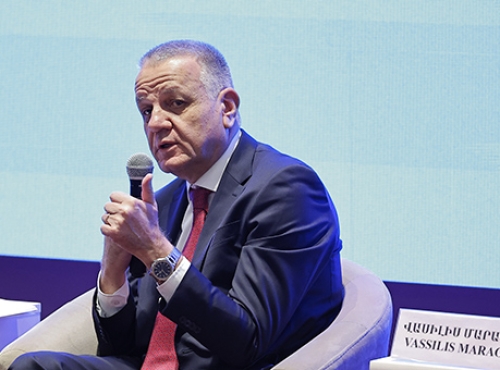
EU Ambassador to Armenia Vassilis Maragos stated during the “Armenia and Peace: At the Crossroads of Risks and Opportunities” forum that the European Union’s programs in Armenia go beyond social and institutional aid, directing substantial funds toward the private sector and regional development, particularly in Syunik.
“We have allocated over €250 million to programs supporting the private sector,” Maragos said, as reported by Armenpress.
He highlighted a specific initiative signed during a visit by EU Enlargement Commissioner Marta Kos, under which the European Bank for Reconstruction and Development is providing €4 million in funding for four programs, including support for displaced entrepreneurs from Nagorno-Karabakh. At least 35% of funding under each program is allocated as a grant.
“For instance, if a project costs €1 million, €350,000 will be a grant,” he noted, calling this a clear example of EU assistance.
The ambassador added that through EU-backed projects, cooperation has been established with about 17,000 small and medium enterprises in Armenia, leading to the creation of over 27,000 jobs.
At the same time, he stressed that such initiatives cannot solve all of Armenia’s economic challenges, noting that primary responsibility lies with the Armenian government. The EU acts as a partner, supporting sustainable growth and economic resilience.
The EU is also supporting infrastructure development, including the construction of the Sisian-Kajaran road, and modernization of border checkpoints. Prime Minister Nikol Pashinyan emphasized the promising field of cooperation with the EU in upgrading or establishing border crossing points.
“For example, we are now building a large and modern customs checkpoint on the Armenia–Iran border within the EU–Armenia partnership,” Pashinyan said.
He also expressed gratitude for assistance provided to Armenia under the European Peace Facility, noting that consensus was reached for the decision, and Hungary withdrew its veto.
Maragos further noted the EU’s involvement in Armenia’s energy sector, aimed at boosting regional connectivity and export potential. This includes the Armenia–Georgia power transmission project, which is currently underway.
In Syunik, the EU has supported infrastructure for solar power stations and encouraged private investment in communities like Masrik near Lake Sevan.
With the completion of these projects, Armenia will be fully integrated into the region’s power grid, enabling increased electricity exports.
According to Maragos, Syunik remains a top EU priority, with over €200 million already invested through various programs.
He cited several projects, including the TUMO center in Kapan, agreements to establish two COAF centers, and the social taxi service in Goris for people with disabilities.
He concluded by emphasizing the EU’s commitment to human rights across all initiatives, guided by the principle that “no one should be left behind,” and said cooperation with local and regional authorities will continue to ensure effective implementation of energy and social programs.