












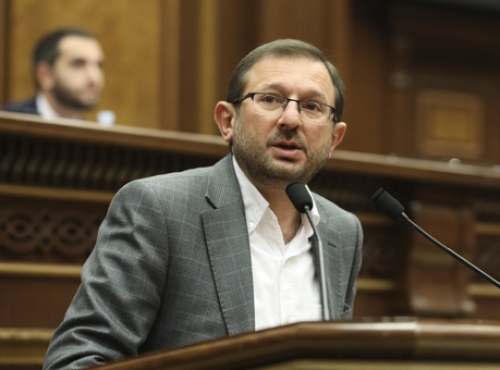
Opposition lawmaker Gegham Manukyan sharply criticized Prime Minister Nikol Pashinyan during a National Assembly Q&A session, raising concerns over media control and alleged pressure on the Armenian Apostolic Church.
Manukyan accused the National Security Service (NSS) and police of becoming instruments of coercion. “What business does a counterintelligence officer have with a priest? If there's a problem, open a criminal case—don’t make the NSS a joke with false reports,” Manukyan said, as reported by Pastinfo.
In response, Pashinyan defended the NSS’s mandate, stating that officers are authorized to carry out counterintelligence operations, including in dealings with clergy.
Manukyan also alleged that the national postal service, Haypost, signed a non-refundable sales agreement with Haykakan Zhamanak, a newspaper formerly associated with Pashinyan, in exchange for not publishing critical material about Mikayel Minasyan.
“But let me say this: Pashinyan is doing the right thing. Former officials who once agreed to stay silent in exchange for favorable coverage are now quiet for a reason. That’s why he can still talk about envelopes,” Manukyan added.
Citing a 1920 article about Bolshevik efforts to create sectarian movements under the guise of “purifying” the church, Manukyan addressed Interior Minister Arpine Sargsyan, questioning why a senior criminal police officer, Artur Zakaryan, was accompanying bishops—suggesting it was a criminal matter.
“You can speak eloquently, but you’re leading disgraceful processes nationwide,” he said, asserting that the NSS and police are now engaged in actions against the church.
Manukyan further noted that a priest in the Masis diocese was forced to retract a public statement, later admitting he had made it under external pressure.
“No matter how prettily you speak, the truth will come out,” he warned.
As Manukyan tried to continue, Parliament Speaker Alen Simonyan cut off his microphone. Pashinyan responded by praising the role of Haykakan Zhamanak, calling it a highly demanded publication and arguing that Haypost benefitted from its sales.
“If Mishik was behind Haypost, that doesn’t mean they paid me. I gave them the opportunity to sell a sought-after product,” Pashinyan said.
He added that Armenia is preparing to defend itself against “agents of influence,” regardless of whether they appear as politicians or clergy. He reminded lawmakers that the state has responsibilities, and what began as the “Velvet” revolution in 2018 had become a “steel mandate” by 2021, applied “as gently as possible.”
Manukyan reiterated that current developments resemble the sectarian policies of the Bolshevik era, citing one of 12 historical points outlining the risk of the church being co-opted as a state or party tool.