
















According to an analysis published by the Atlantic Council, the U.S.-backed TRIPP initiative, which would pass through southern Armenia, has the potential to reshape the geopolitical dynamics of the South Caucasus. The think tank argues that the project could become one of the most consequential foreign policy undertakings of President Donald Trump’s second term.
As described by the Atlantic Council, the corridor is envisioned as a strategic link between Europe and Asia. The concept reportedly emerged during peace negotiations in 2025, when Azerbaijan sought to activate the Nakhichevan access provision of the 2020 ceasefire agreement, while Armenia emphasized the importance of maintaining full sovereignty over its territory.
The Atlantic Council notes that the Trump administration proposed what it characterizes as an innovative compromise: placing the design and management of the route under a U.S.-led consortium working in coordination with Armenian authorities. In the center’s assessment, this structure would grant Azerbaijan access to Nakhichevan while formally preserving Armenia’s territorial integrity.
Citing public statements, the article recalls that U.S. Secretary of State Marco Rubio and Armenian Foreign Minister Ararat Mirzoyan announced the establishment of the TRIPP Development Company (TDC), tasked with implementing the project’s initial phase, including road and rail construction. Under the reported arrangement, the United States would hold a 74 percent controlling stake in TDC for 49 years, gradually decreasing to 51 percent over the following five decades.
According to the Atlantic Council’s analysis, initial U.S. government funding would be recouped through transit fees and commercial revenue generated by TDC. Armenia, in turn, would benefit from its minority stake as well as from tax and customs revenues along the route.
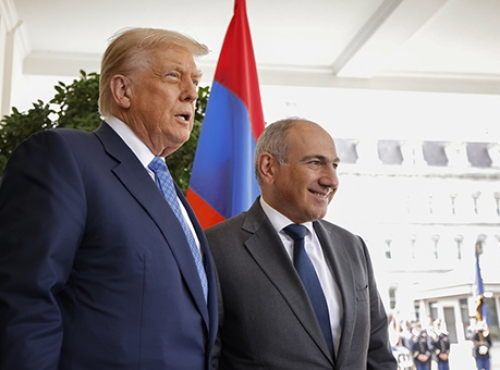
The think tank suggests that the White House could present TRIPP as a diplomatic and economic success, while Armenian Prime Minister Nikol Pashinyan may frame it domestically as a channel for high-quality Western investment. In the Atlantic Council’s view, the project aligns with Armenia’s Crossroads of Peace concept, which positions the country as a sovereign regional transit hub.
The analysis further argues that TRIPP could deliver medium- and long-term benefits for Washington, Yerevan, and the broader Caspian region. While not always emphasized publicly, the Atlantic Council points out that the United States has supported the Middle Corridor as an alternative Asia-Europe trade route that bypasses Russia. In this context, the corridor could also facilitate exports of rare earths and minerals from Central Asia.
The article notes that several regional states are pursuing economic growth through deeper integration into global markets, and that TRIPP could support these ambitions by increasing transit capacity. Azerbaijan and Kazakhstan, the authors observe, have already invested in port infrastructure. If successful, TRIPP could reduce transportation costs and shorten delivery times between Central Asia and Europe.
At the same time, the Atlantic Council cautions that the project carries risks. The South Caucasus, it notes, has previously been used as a corridor for sanctions evasion involving Russia and Iran. The initiative’s long-term viability, the analysis adds, will depend on sustained Asia-Europe trade demand. A rise in Middle Corridor costs or renewed reliance on routes through Russia or Iran could undermine the project.
The think tank also interprets TRIPP as a marker of Prime Minister Pashinyan’s continued pivot toward the West. As the article argues, Armenia’s long-standing dependence on Russia for security was shaken by Moscow’s limited response during the 2020 war, prompting Pashinyan to pursue what the authors describe as comprehensive peace as a path toward greater independence.
While Armenia has expanded defense cooperation with countries such as India, France, Greece, and Cyprus, the Atlantic Council contends that the United States is perceived in Yerevan as uniquely positioned to counterbalance Russian influence. By facilitating peace talks and embedding U.S. economic interests through TRIPP, the analysis suggests that Pashinyan and Azerbaijani President Ilham Aliyev have reached a sensitive arrangement under Washington’s mediation.
The article also highlights concerns from other regional actors. Iran, it notes, has repeatedly described any alteration to its northern border with Armenia as a “red line.” The Atlantic Council recalls that Tehran conducted military exercises near the Azerbaijani border in 2022 amid fears of territorial changes, and references recent remarks by Ali Velayati, an adviser to Iran’s supreme leader, warning against U.S. involvement.
However, the authors argue that Iran’s current response has been more restrained than in the past, reflecting Tehran’s weakened position. As an illustration of Armenia’s diverging approach from Russia, the analysis points to Deputy Foreign Minister Vahan Kostanyan’s recent visit to Israel to coordinate TRIPP-related activities.
According to the Atlantic Council, these developments come at a politically sensitive time, ahead of Armenia’s 2026 parliamentary elections. The think tank suggests that Pashinyan faces pressure to demonstrate that his peace agenda and Western orientation deliver tangible benefits. It points to early signs such as reported Azerbaijani oil and gas supplies to Armenia, which the article claims have contributed to a nearly 15 percent reduction in fuel prices.
The analysis adds that improving relations with Azerbaijan and Turkey, combined with deeper economic integration, could position Armenia as a key transit state with access to European markets.
At the same time, the Atlantic Council notes growing resistance from Moscow. Citing reporting by CivilNet, the article refers to an increase in disinformation campaigns linked to anonymous accounts and Russian-language Telegram channels, suggesting that Russia may intensify such efforts as Armenia’s elections approach.
In conclusion, the Atlantic Council characterizes the launch of TRIPP as a significant milestone in President Trump’s trade-oriented foreign policy and as a potential model for similar initiatives elsewhere. The think tank argues that excluding Russia and Iran from the process could reduce regional economic vulnerabilities and provide leaders such as Pashinyan and Aliyev with greater room to pursue what it describes as sovereign national interests.
Armenian Foreign Minister Ararat Mirzoyan and U.S. Secretary of State Marco Rubio signed a document in Washington formalizing cooperation within the Trump Route for International Peace and Prosperity (TRIPP) project.
The TRIPP implementation document outlines the launch of the initiative. It does not create binding legal obligations for either Armenia or the U.S.