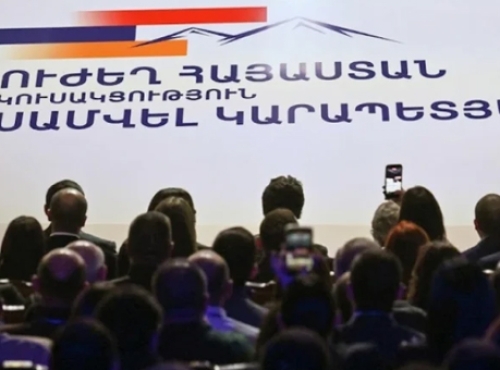

















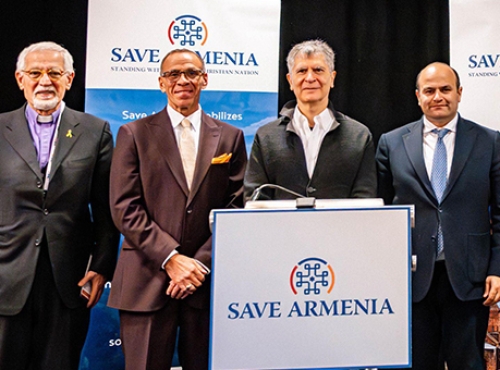
On February 3, Armenian Ambassador to the U.S. Narek Mkrtchyan delivered remarks at the “Save Armenia 2.0 Launch” event, outlining Armenia’s position on protecting freedom of religion and belief as a fundamental human right.
He emphasized that freedom of religion is essential for individual identity, moral agency, and personal values, enabling people to express their beliefs without fear, coercion, or discrimination.
Highlighting Armenia’s unique history as the first country to adopt Christianity as a state religion, Mkrtchyan noted that modern Armenia is a secular state where all citizens are equal before the law, regardless of religious affiliation.
He pointed to Armenia’s religiously diverse environment, where alongside the historic Armenian Apostolic Church, communities such as Yezidi, Jewish, Muslim, Catholic, Evangelical, and others freely practice their faiths within the same legal framework.
The ambassador stressed that safeguarding freedom of belief fosters social stability and democratic resilience, warning that the politicization or manipulation of religion could deepen divisions and threaten long-term security.
Mkrtchyan also expressed regret that the International Religious Freedom Summit platform “had been used by a political movement led by oligarchs to undermine Armenia’s democratic path and influence electoral processes.”
In closing, Ambassador Mkrtchyan reaffirmed Armenia’s dedication to defending freedom of religion both domestically and globally, describing it as a cornerstone of democratic stability and lasting peace. He ended with a quote from Proverbs 16:8: “Better a little with righteousness than much gain with injustice.”
Prime Minister Nikol Pashinyan and bishops calling for the resignation of the Catholicos have issued a joint declaration urging participation in the reform of the Armenian Apostolic Church. Pashinyan read the statement live on Facebook, after which supporting clergy signed it. A coordinating council has been formed to oversee the reform process, with decisions made by consensus. The statement also included a roadmap calling for the Catholicos’ removal, election of a locum tenens, a new church constitution, and the election of a new Catholicos.