
















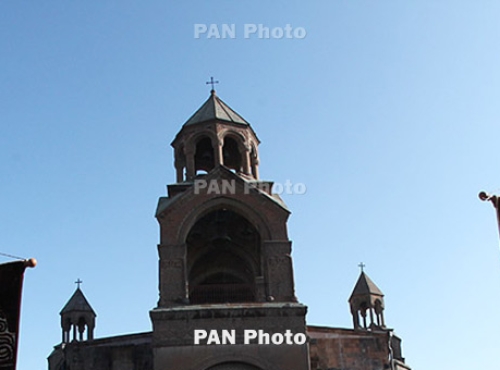
Prominent diaspora figures said sustained attacks on the leadership of the Armenian Apostolic Church and threats to forcibly remove its head pose a direct threat to Armenians worldwide who rely on the Church for spiritual guidance.
A statement was signed by Armenian-American entrepreneur and philanthropist Nubar Afeyan, Armenian Assembly of America Board of Trustees Co-Chair Anthony Barsamian, Denham Professor Lord Ara Darzi, Armenian-American producer Eric Esrailian, Swiss-Armenian businessman and philanthropist Vache Gabrelian, British-Armenian businessman and philanthropist Vache Manukyan, Amber Capital Chief Executive Officer Joseph Oughourlian, and the seventh president of the Armenian General Benevolent Union, Berge Setrakian.
They signed the letter as “descendants of survivors of the Armenian Genocide and members of the global Armenian Church.”
“In recent months, prolonged political disagreement in Armenia, including escalating conflict between leaders of Armenia’s government and the Armenian Apostolic Church, has reached a peak, with the government demanding the removal of the Church’s leader despite his legitimate election in accordance with the regulations of the National-Ecclesiastical Assembly. Several archbishops have been imprisoned on accusations of making political statements, and a prominent Russian-Armenian philanthropist and businessman has been jailed for publicly supporting the Church’s position.
Sustained attacks on the Church’s leadership and threats of forcibly removing its head constitute a direct threat to all Armenians around the world who depend on the Church for spiritual nourishment.
We call for all matters related to church governance to be resolved through the Church’s governing bodies, which have functioned for 18 centuries in accordance with the teachings and traditions of the Armenian Apostolic Church. The Church has already convened a bishops’ assembly to be held in Vienna from February 17 to 19. Regrettably, the government has reportedly served legal notices to several bishops, denying them the right to leave the country freely and participate in the assembly. The assembly will be followed by a meeting of the National-Ecclesiastical Assembly to discuss current challenges and propose a path of renewal consistent with the Church’s longstanding traditions and canons.
The Church’s self-governance is of paramount importance for continuous improvement and reform. It organizes regular assemblies of its bishops, as well as National-Ecclesiastical Assemblies, which importantly include both laypeople and clergy. This body is the Church’s highest governing authority, and only it elects the Catholicos. The Assembly may also vote on amendments to the Church’s canons, regulations and religious orders.
We urge the government of Armenia and the Armenian Church to resolve all disagreements while respecting the Church’s rules of self-governance, upholding the separation between political activity and the Church’s mission, and protecting the right of diaspora Armenians to practice their faith without the impact of political interference by the government. For descendants of the victims of the Armenian Genocide, the memory of the failed mission to destroy all Armenians and our long path of rebirth that followed make current developments especially painful and threatening. It was the Church that helped the population survive and revive after the Genocide; it was the Church that helped restore the Armenian spirit, and it is that same Church that is essential for the flourishing of a globally dispersed nation. Even if unintentional, the Armenian government’s approach risks severing its relationship with the diaspora — something even the Ottoman Empire or the Soviet Union failed to do.
The Armenian Church provides spiritual nourishment to all Armenians, including the majority who live outside Armenia. Any attack or interference by an individual, government or external body in the Church’s governance or operations directly affects Armenians worldwide. As current citizens of the United States and many other countries, diaspora Armenians are obliged to seek assistance from our own governments, including political means and, if necessary, legal action, to protect our religious rights. These rights include reliance on the self-governance of the Armenian Apostolic Church, grounded in established canons and traditions dating back to the earliest days of Christianity.
Armenia stands at a critical crossroads in its history. Internal divisions between Church and state in Armenia must not further weaken the global Armenian nation. The time has come to calm this internal crisis so that the Armenian state, the Armenian Church and the Armenian diaspora can move toward a new era of peace and prosperity,” the statement said.
They called on all Armenians in the diaspora to raise their collective voices and demand the realization of their right to practice their religion in a self-reforming church free from political interference.
Prime Minister Nikol Pashinyan and bishops and archbishops demanding the Catholicos’ resignation also issued a statement calling for joining the reform of the Armenian Apostolic Church. Pashinyan read the statement during a Facebook livestream, after which the bishops and archbishops who joined it signed the document. Pashinyan said a coordinating council is being formed and tasked with organizing reform of the Armenian Apostolic Church. The council may be expanded only by unanimous decision.
The statement also published a roadmap for Church reform with the following agenda: promotion of the reform agenda; removal of the de facto head of the Church; election of a Locum Tenens; adoption of a church charter; and election of the Catholicos of All Armenians.