










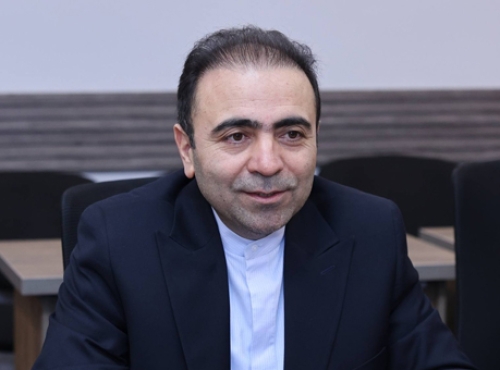
It is possible that Armenian-Iranian joint military exercises will be held again in the future and may even become larger in scale, Iran’s newly appointed Ambassador Extraordinary and Plenipotentiary to Armenia, Khalil Shirgholami, said.
He made the remarks while attending a ceremony awarding Professor Vardan Voskanyan, head of the Iranian Studies Department at Yerevan State University’s Faculty of Oriental Studies, honorary membership in the Academy of Persian Language and Literature, Sputnik Armenia reports.
Special forces units of the Armenian and Iranian armed forces held joint exercises in April 2025.
“Given the relations and ties between our two countries in various fields, including defense, such events are routine and ongoing. It is possible that similar events will take place again in the future, and they may be more large-scale,” the ambassador emphasized.
Responding to a question about whether Armenian Defense Minister Suren Papikyan’s visit to Iran had long been planned or should be viewed in the context of tensions surrounding Iran, Shirgholami said the visit had been scheduled in advance.
“This reflects the cooperation and ties between the two countries in various fields. The visit was planned through different delegation formats of both sides. During the visit, the parties will have the opportunity to exchange views on various issues and further deepen the existing cooperation,” the ambassador said.
According to him, the Armenian-Iranian border has always been a border of peace and holds special importance for both countries.
“The military sectors of both countries are based precisely on these historical ties and on the principles of preserving the inviolability of the border and the territorial integrity of both states,” Shirgholami noted.
The ambassador added that the two countries are moving in the right direction in various areas — academic, economic, political and cultural — and are developing cooperation on a daily basis, which will allow new achievements to be recorded in the future.
Commenting on earlier sharp remarks he had made in January regarding anti-Iran protests held near Iran’s embassy in Armenia and statements by Armenian authorities against that backdrop, Shirgholami thanked the relevant Armenian bodies for the steps taken.
“The events we witnessed in Iran initially began as peaceful demonstrations, which organized groups imported from abroad tried to steer in a different direction and drag the country into internal conflict. Political actions and regime-change slogans under such circumstances are condemnable. Those people are also our citizens; we love them as well. We are confident that disagreements arising within our family must be resolved within the family,” Shirgholami said.
Mass protests in Iran began on December 28, 2025. The main reasons for the unrest were exchange rate fluctuations and rising prices. Later, in a number of cities, the demonstrations escalated into clashes with police, and the slogans took on a political character directed against Iran’s political system. On January 2, U.S. President Donald Trump said the United States was ready to protect Iranian citizens if authorities used force against them, a statement condemned by Tehran.
On January 8, the largest protests took place in Iran, reportedly prompted by a call from Reza Pahlavi, the son of the shah overthrown in 1979. Supporters of the current authorities also took to the streets afterward.