













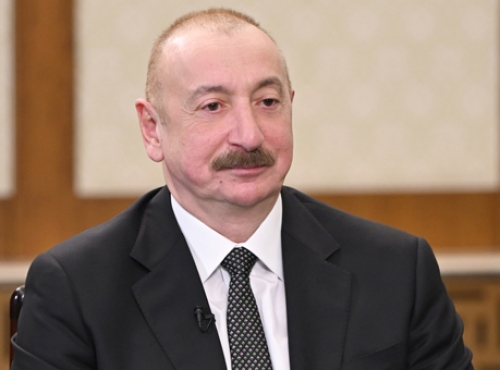
The Lemkin Institute for Genocide Prevention has expressed deep concern over recent statements by Azerbaijani President Ilham Aliyev, in which he compared Armenian political prisoners and prisoners of war with Nazi leaders convicted during the Nuremberg trials.
The institute described Aliyev as the leader of a genocidal state, saying the country’s institutions are permeated by genocidal ideology, its policies are shaped by genocidal agendas, and such rhetoric serves as a key source of domestic legitimacy, Sputnik Armenia reported.
According to the institute, Aliyev has institutionalized genocidal anti-Armenian hatred within state bodies and public life.
In an interview with France 24 on February 13, Aliyev said that calls to release “former leaders of Karabakh” were “the same, or even worse, than what the Nazis did during World War II.”
The institute said such remarks are particularly dangerous amid the Israel–U.S. war against Iran, which has placed Azerbaijan in the position of an important wartime ally and, in the institute’s view, provided Aliyev with greater impunity.
“Aliyev’s comparison does not reflect historical reality but distorts it. Azerbaijan is bringing false accusations against Armenians it still holds and justifies its illegal actions by comparing them with Nazi war criminals and architects of genocide,” the statement said.
It added that the only “crime” committed by former members of the Nagorno-Karabakh government currently held in Baku was that they exercised their right to self-determination and tried to defend the enclave’s Armenian population from Azerbaijani aggression.
“Unfortunately, world leaders appear all too willing to tolerate the international crimes of what has now become a respected genocidal dictator,” the statement said.
The Lemkin Institute also said Aliyev’s remarks demonstrate a tactic often used by genocidal states known in psychology as DARVO — deny, attack, and reverse victim and offender.
According to the institute, Aliyev first denies credible allegations of atrocities, then portrays Armenians as alleged war criminals, and finally reverses the narrative by presenting Azerbaijan as the victim and Armenians as an existential threat.
Such rhetoric not only deepens tensions but can also make genocide appear justified, the statement said.
The institute added that Aliyev’s remarks also represent a dangerous form of genocide denial. It said that by trivializing the Holocaust, he simultaneously denies the destruction of Armenian life in Nagorno-Karabakh, refuses to accept responsibility for the mass forced displacement organized by his government, and uses Holocaust memory to mask broader genocidal ambitions in the South Caucasus.
The statement also expressed concern over the continued detention and prosecution of Armenian prisoners in Azerbaijan from the perspective of international humanitarian law.
It noted that the Third Geneva Convention requires humane treatment of prisoners of war and prohibits their forced prosecution.
“Throughout the trials there have been testimonies of torture against Armenian prisoners by relevant Azerbaijani agencies. Amnesty International and others have expressed concerns about the rights of former leaders of Artsakh held in captivity, particularly regarding their right to a fair trial,” the statement said.
The institute said Azerbaijan should either release the detainees or ensure transparent legal processes in line with its international obligations.
The Lemkin Institute also warned that history shows perpetrators of atrocities often use extreme rhetoric to justify extraordinary measures.
They portray targeted groups as criminals, terrorists, or enemies, invoke past traumas to legitimize present repression, and frame collective punishment as a moral necessity — behavior that often serves as an early warning sign of further violence, the institute said.
The organization called on Azerbaijani authorities to stop dehumanizing and genocidal rhetoric against Armenians, refrain from using the Holocaust to justify their actions, and immediately release all Armenian detainees.
Since Aliyev himself has said he does not intend to do so, the international community should exert pressure on him, the institute added.
According to the institute, such pressure should focus particularly on Aliyev personally, noting that his hold on power relies significantly on support from Western countries.
It warned that if the Western world continues to encourage the Azerbaijani president without taking action, more serious problems could arise in the future.
The greater Aliyev’s impunity becomes, the greater the risk that he will attempt to implement plans for a “Greater Azerbaijan”, which the institute said include the territory of the Republic of Armenia.
The international community must not allow historical memory to be manipulated to serve ongoing genocidal agendas, the institute said.
Aliyev said in the same February 13 interview that calls to release Armenian detainees could be compared to a situation in which the Allies were asked to free Nazi officials before their verdicts were delivered.