
















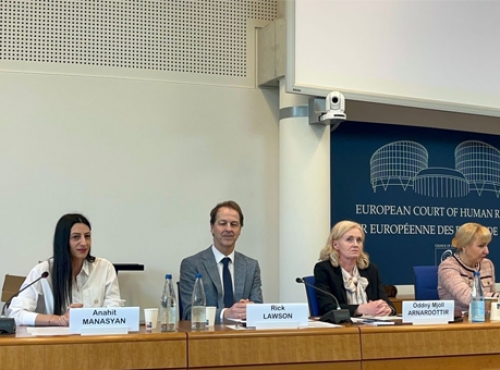
Armenia’s Human Rights Defender Anahit Manasyan said that discriminatory speech is widely распространed in Armenia, as in many other countries.
She made the remarks in Strasbourg while speaking at a high-level conference of ombudsman institutions organized by the Council of Europe on March 12–13.
Manasyan delivered a keynote address on the challenges related to freedom of expression and the prevention of hate speech.
The Armenian delegation also included Tigran Manukyan, the Youth Representative of the Human Rights Defender, who represents the public council on the protection of children’s and youth rights attached to the ombudsman’s office.
“It is a great honor for me to participate in this high-level conference and address the challenges in the field of freedom of expression. This is an area of particular importance for strengthening the rule of law and democracy, but it is also a field where numerous challenges exist in the modern world,” Manasyan said.
In her speech, she stressed the importance of guarantees for freedom of expression and the safety of journalists, while also addressing existing problems — particularly the growing spread of hate speech and discriminatory rhetoric, which she said has become more visible amid rapid technological development and various political processes.
“In our country, as in several others, the spread of discriminatory speech is extremely serious. Such rhetoric can often be found on the basis of national or ethnic origin, disability, religious beliefs, gender equality issues and several other grounds.
This field is frequently instrumentalized by political actors, including through large-scale disinformation campaigns,” the ombudsperson said.
Manasyan also presented examples of discriminatory speech and disinformation targeting various groups, including women and children, people with disabilities and national minorities.
She further warned about the dangerous level of targeting against human rights defenders in the modern world.
The ombudsperson emphasized the need for proper disciplinary accountability mechanisms for public officials, as well as members of professional and academic communities, to prevent such phenomena.
At the same time, she stressed that criminal liability mechanisms for hate speech and other prohibited forms of speech should not be abused.
Summing up her remarks, Manasyan said systemic reforms are needed to address these challenges, highlighting in particular the importance of changing mindsets, strengthening human rights education and improving law enforcement practices.
The session was moderated by European Court of Human Rights judge Diana Kovacheva.
Participants in the panel discussion also included European Court of Human Rights judge Oddný Mjöll Arnardóttir and Rick Lawson, president of the Netherlands Institute for Human Rights.
Opening remarks were delivered by Matthias Guyomar, president of the European Court of Human Rights, Michael O’Flaherty, Council of Europe Commissioner for Human Rights, Louise Holck, president of the European Network of National Human Rights Institutions (ENNHRI) and director of the Danish Institute for Human Rights, and Marialena Tsirli, registrar of the European Court of Human Rights.