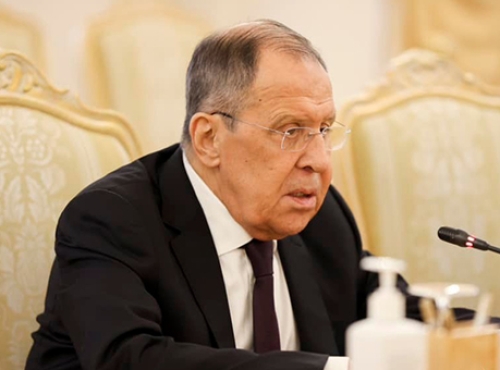












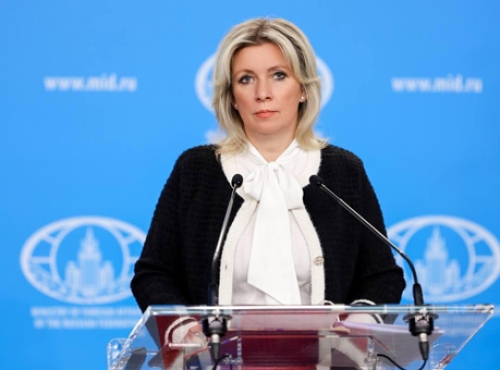
Armenia’s European development vector raises questions, as EU standards are often presented as unconditional advantages, said Russian Foreign Ministry spokeswoman Maria Zakharova, commenting on Prime Minister Nikol Pashinyan’s speech in Strasbourg.
According to her, the logic suggesting that Armenia would benefit both with and without European integration appears contradictory. Zakharova compared such an approach to a situation where a person wins a game of chess against themselves, «Sputnik Armenia» reports.
She also noted that European standards are presented in an abstract manner, without a clear understanding of their practical foundations.
“As a result, an attractive but largely declarative picture is formed,” the Russian Foreign Ministry representative stressed.
In this context, Zakharova pointed to internal problems within the European Union, including a decline in industrial production, rising public debt, and the migration crisis.
She also expressed bewilderment that Armenia seeks to adopt European standards without participating in their development.
“Meanwhile, within Eurasian integration frameworks — the CIS and the EAEU — Armenia is a full-fledged participant not only in the institutions themselves but also in decision-making processes,” she added.
Zakharova emphasized that within Eurasian integration blocs, all standards and decisions are formed with the participation of member states through joint development and approval. According to her, the EAEU demonstrates stable economic dynamics and is increasing its share in global GDP.
She stated that Armenia’s economy maintains high growth rates largely due to its ties with the EAEU: in 2025, GDP growth, by her estimate, exceeded global averages and amounted to more than 7–7.2%.
“We have repeatedly stated that simultaneous participation in European and Eurasian integration projects is impossible. This contradicts logic, common sense, and economic laws. It is unrealistic to expect the implementation of EU standards that would not conflict with EAEU norms and regulations,” she said.
At the same time, Zakharova stressed that Russia considers the choice of future direction to be Armenia’s sovereign right. However, Moscow expects the Armenian side to consistently fulfill its obligations within the EAEU framework and not create obstacles for Russian business, or to clearly define its position on this issue.
Zakharova also touched upon relations between Armenia’s authorities and the church.
“In this context, references to so-called ‘KGB agents’ are essentially aimed at gaining the support of a Western audience, which apparently continues to think in an anti-Soviet paradigm that evolves into Russophobia,” she said.
According to her, politicizing religious issues and attempts to marginalize matters of faith and clergy are extremely dangerous. Zakharova stressed that such approaches could deepen divisions within society.
On March 11, speaking in Strasbourg at a plenary session of the European Parliament, Armenian Prime Minister Nikol Pashinyan said that a key issue in Armenia’s European integration is the frozen state of political dialogue between the EU and Georgia. He recalled that Armenia’s parliament adopted a law to initiate the process of EU accession after Georgia received EU candidate status, which made Armenia’s own prospects for membership more tangible.
Armenia remains a member of the EAEU while simultaneously declaring its intention to deepen cooperation with the EU. Discussions about leaving the Eurasian Economic Union began after Armenia’s parliament adopted a bill on March 26, 2025, expressing intent to join the European Union. No membership offer has been made by the EU.