













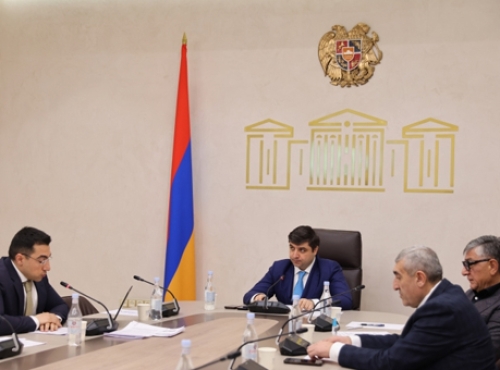
Armenia’s National Assembly Standing Committee on Regional and Eurasian Integration discussed the progress and results of the government program (2021–2026) for 2025 at its March 20 session. Representatives of relevant agencies presented performance indicators and completed work.
Deputy Foreign Minister Mnatsakan Safaryan outlined the Foreign Ministry’s activities and key areas of cooperation. In 2025, two sessions of the Supreme Eurasian Economic Council, four intergovernmental council meetings, and 11 sessions of the Eurasian Commission Council were held, during which about 150 decisions and 70 directives were adopted.
Leaders of the Eurasian Economic Union (EAEU) approved an action plan for the development of integration processes until 2030 and 2045. The Foreign Ministry continued active participation in EAEU meetings and in drafting, refining, and coordinating initiatives.
Within the CIS format, Armenia took part in one meeting of the Council of Heads of State, two meetings of the Council of Heads of Government, two meetings of foreign ministers, and four meetings of the Economic Council, adopting about 150 documents. Cooperation with CIS foreign ministries also continued.
In the reporting year, dialogue with Russia continued at high and highest levels: five phone calls and four meetings took place between Armenia’s prime minister and Russia’s president. Trade turnover between the two countries reached about $7.7 billion, decreasing by 38.3% compared to the previous year.
Mutual visits also took place, including Armenia’s foreign minister visiting Russia and Russia’s foreign minister visiting Armenia. In June, Yerevan hosted the 10th anniversary interregional cooperation forum, and in December the 24th session of the intergovernmental commission on economic cooperation. Cooperation with Kazakhstan was also presented.
Deputy Finance Minister Armen Poghosyan presented fiscal policy measures, highlighting improvements in macroeconomic forecasting systems, which allowed more efficient planning of public resources and increased policy effectiveness. Mechanisms for assessing fiscal risks were also improved.
Public debt remains within manageable limits, reaching 5.5 trillion drams (about $14.5 billion) by the end of 2025. The share of debt denominated in drams increased to 52.9%. Domestic borrowing financed a budget deficit of 297 billion drams.
The effectiveness of ongoing cooperation with international financial institutions was also noted.
Economy Minister Gevorg Papoyan said Armenia’s trade turnover with EAEU countries exceeded $8 billion, with exports surpassing $3.2 billion. In 2025, tourist arrivals exceeded 2.263 million, marking a 2.5% increase. Russian tourists accounted for about 938,000, or 43% of the total.
It was also noted that within the EAEU framework, Armenia secured tariff preferences for importing key goods, contributing to food security and economic stability.
Other areas of activity were also presented during the session, and officials answered questions from lawmakers.