












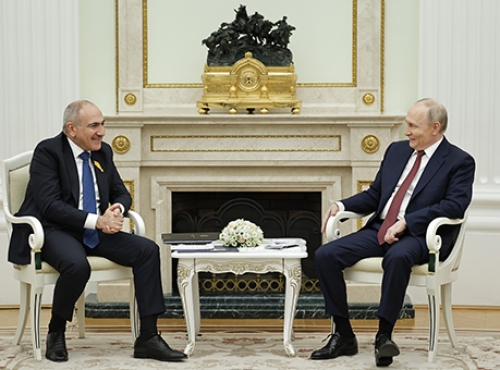
Russian President Vladimir Putin conveyed a message that was both diplomatic and politically devastating, former Armenian Foreign Minister Vartan Oskanian said, commenting on the meeting between Putin and Prime Minister Nikol Pashinyan in Moscow.
In a Facebook post, Oskanian argued that the symbolism Pashinyan tries to convey with the map of Armenia pinned to his chest produces the opposite effect.
“Addressing Armenia’s economic ties, security issues, mentioning Nagorno-Karabakh, Pashinyan’s unrealistic expectations from relations with the European Union, and even hinting at upcoming elections, he was not merely summarizing bilateral relations and regional issues. He was clearly formulating a contrast between what Armenia once had, what it has lost, and what it may still lose.
Putin’s preface was essentially a verdict on Pashinyan. If we strip away the diplomatic wording, the message was clear: you do not seem to understand what you are doing, you are on the wrong path, and if you continue this way, you will cause far greater damage to the Armenian people than you already have.
At one point, I even expected Putin to ask Pashinyan what he was wearing on his jacket. Supposedly, it is a map of Armenia. Pashinyan wears that map to emphasize that the Nagorno-Karabakh issue is closed. But who wears a map on their chest? Has anyone seen a leader of another country do that? A flag — yes, but a map? Imagine the opposite: Putin wearing a map of Russia, including Donbas, during international meetings.
In my opinion, what Pashinyan is trying to convey with this symbol has the exact opposite effect. That map, on Pashinyan’s chest, becomes a constant reminder for the Armenian people that Nagorno-Karabakh was lost unnecessarily during his rule, due to his grave mistakes.
Moreover, when a country’s leader carries a map of their own perceived state on their chest, it reveals a deeper internal insecurity — that even this territory is not stable or secure, that it too could be lost, and must be pinned on the chest to convince oneself and others that at least this can be preserved. Because, rightly, there is fear that even that cannot be maintained,” Oskanian wrote.
During the meeting, Putin stated: “The most sensitive issue remains everything related to Karabakh. We discuss it constantly. We know that both you and your colleagues have had and still have questions and certain dissatisfaction regarding the Collective Security Treaty Organization (CSTO). We always return to this issue. But it is also evident that after you recognized in Prague in 2022 that Karabakh is part of Azerbaijan, CSTO intervention in this process, which has taken on an internal Azerbaijani character, would have been absolutely wrong in connection with Karabakh’s reunification, if we consider it part of Azerbaijan. This is not an assessment— I am not saying whether it is good or bad — but from the perspective of organizing peaceful life, it probably made sense.”