
















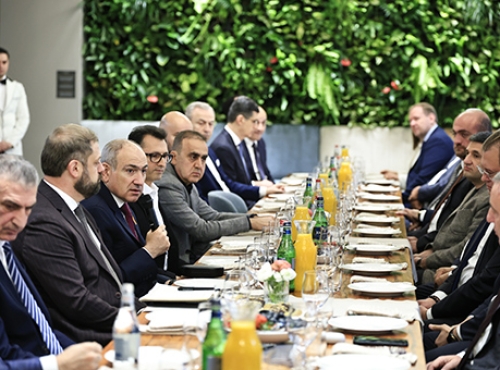
Prime Minister Nikol Pashinyan, during a working breakfast with major employers in Armenia, discussed employment, the role of artificial intelligence in the economy, and “reliable transport routes” with Azerbaijan.
He noted that since 2018, these companies have responded to government policies, contributing to the creation of 288,000 jobs in the country.
Pashinyan also addressed the introduction of artificial intelligence into the economy, pointing out potential risks, including those related to employment. He stressed the importance of analytical and practical work to ensure a smooth transformation of the labor market.
“We need to understand what we have to do and in which directions we should cooperate in order to ensure the proper transformation of the labor market,” he said.
The prime minister highlighted that in recent years the government has invested billions of drams in modernizing the economy and boosting productivity, mentioning the Economic Modernization Program as a key driver of economic activity. He added that since 2018, despite the pandemic and war, Armenia has recorded an average economic growth of about 7%, thanking businesses for their role.
He also spoke about the expansion of the universal health insurance system, wages, and the role of employers in increasing coverage.
Touching upon social policy, Pashinyan emphasized that able-bodied citizens should ensure their well-being through work.
“We will guide individuals toward employment. In the social support system, a mandatory condition has been introduced: we must offer a person a concrete job with a specific salary. If the offer is declined three times, we will assume the person has income, because if someone has no income, why refuse work? Of course, the most important element in all this is education and its reform,” he said.
The prime minister stated that Armenia has entered a new stage of economic development, also linked to the ongoing peace process between Armenia and Azerbaijan.
“We expect major developments soon, primarily related to the launch of the TRIPP project, which is significant because it will ultimately fully lift Armenia out of blockade. In fact, Armenia has already overcome the blockade to some extent, as railway cargo transportation to Armenia through Azerbaijan’s territory is possible and is being carried out. Exports are also possible via railway through Georgia until we open the railway with Azerbaijan within the TRIPP framework.
This is very important, and the political agreement is that this railway will never be closed. That means it will be a reliable route for both imports and exports,” he said.
Summing up, Pashinyan noted that since 2018, Armenia’s GDP has grown by 53% in real terms, bringing the economy to a new level that requires rethinking relations between the state and business, as well as employees and employers.
“We must acknowledge the role of companies that have brought new mentality, new thinking, and a new culture to Armenia. This is the most important capital, opening new opportunities and fields of activity,” he concluded.
Further discussions focused on government measures for economic development, investment tools, improving the investment climate, and addressing existing challenges.