











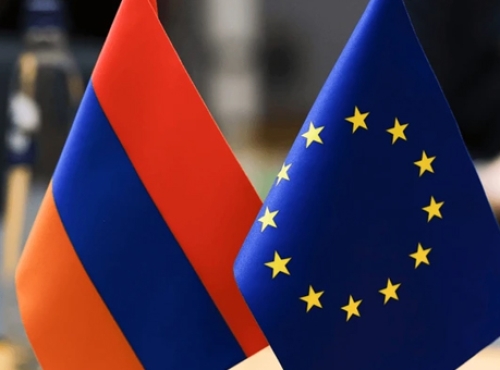
Six Armenian political parties have jointly appealed to the European Union leadership, citing what they describe as anti-democratic developments in Armenia, along with humanitarian and regional concerns.
The letter is addressed to EU leaders, participants of the upcoming European Political Community summit in Yerevan, and heads of European political groups. It highlights “anti-democratic trends in Armenia, as well as issues concerning compatriots held in Azerbaijan and the people of Artsakh.” The text was published on Facebook by Armen Ashotyan, Vice President of the Republican Party of Armenia.
The signatories include the Republican Party of Armenia and the Heritage Party (European People’s Party), the Armenian Revolutionary Federation (Socialists and Democrats), Prosperous Armenia (European Conservatives and Reformists), the Armenian National Congress (Alliance of Liberals and Democrats for Europe), and the Artsakh Democratic Party (European Free Alliance).
The letter states:
“Dear colleagues, as representatives of Armenian political parties affiliated with your European political families and united by a commitment to democracy, rule of law, and fundamental freedoms, we address you ahead of the European Political Community summit in Yerevan.
The Armenian government is shaping an international image of democratic progress, but this message is misleading. In our view, the administration of Nikol Pashinyan is consolidating power, weakening checks and balances, and using law enforcement and judicial mechanisms against political opponents and clergy.
Holding the summit under such conditions risks signaling that democratic backsliding can be overlooked when politically convenient.
We urge you not to ignore the following:
Democratic backsliding and political pressure. Armenia’s democratic indicators have declined, as reflected in assessments by Freedom House, Transparency International, and the V-Dem Institute. Judicial and law enforcement systems are increasingly used for political purposes. Peaceful protests are restricted, and activists face threats and detention.
Political prisoners. More than 50 individuals are reportedly detained on politically motivated charges, with numbers rising. Continued silence risks normalizing such practices.
Pressure on the Armenian Apostolic Church. Authorities are using legal and administrative measures, including travel restrictions, to increase control over the Church. Clergy have reportedly been detained on fabricated charges, and courts used against church structures. The ruling Civil Contract party has also included the removal of the Catholicos in its political agenda, which is described as unconstitutional interference.
Pressure on media and limits on free speech. Independent media face growing restrictions. Journalists encounter attacks, threats, and loss of access to state resources, narrowing the space for free expression.
The letter also raises concerns about actions by Azerbaijan affecting prospects for peace in the region.
Armenian prisoners of war in Azerbaijan. According to official data, 19 Armenian prisoners of war and civilians remain in custody. Reports of torture and staged trials persist. The issue of missing persons remains unresolved, while the lack of transparency deepens humanitarian concerns.
Ethnic cleansing in Artsakh and the need for return. The forced displacement of the Armenian population of Nagorno-Karabakh must not be ignored. The destruction of Armenian cultural and religious heritage is also highlighted. The letter stresses that international law obliges Azerbaijan to ensure the safe and dignified return of displaced persons.
The authors emphasize:
This is a moment of political clarity, and engagement must not come at the expense of principles.
They call on EU leaders to:
— demand the release of all political prisoners in Armenia and Armenian prisoners of war in Azerbaijan;
— speak out against pressure on the Church and restrictions on media freedom;
— ensure balanced engagement with opposition groups, civil society, and the Church.
“The credibility of Europe’s commitment to democratic values is at stake. We urge consistent action to defend democracy,” the statement says.
Large-scale events are scheduled in Armenia on May 3–5, including the 8th European Political Community summit, the Armenia–EU summit, and the Yerevan Dialogue initiative, with participation of foreign delegations.