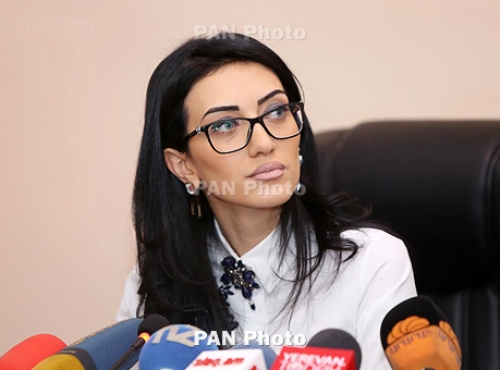












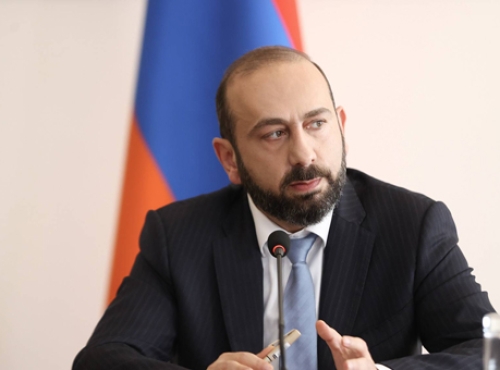
Armenian Foreign Minister Ararat Mirzoyan said the nation must focus on the present and future rather than remain in the past, in an interview with France 24 journalist François Picard ahead of the first EU–Armenia summit, Factor.am reported.
According to the broadcaster France 24, he represents the country at a pivotal moment defined by simultaneous peace-building and strategic realignment. Mirzoyan asserted that “there is now peace between Armenia and Azerbaijan,” describing it not as a symbolic claim but as an emerging reality, further underscored by intentions to “institutionalize this peace.”
He framed this development within a broader historical shift. After “decades of blockade,” Armenia is now seeking to redefine its regional role.
“This is not about competition, but about unblocking the South Caucasus,” Mirzoyan said.
In his view, the country’s future is tied to expanding connectivity through large-scale infrastructure projects, including railways, power grids, and oil and gas pipelines. These efforts could position Armenia as “the most important link of the Middle Corridor” connecting Europe and Asia.
However, this optimistic vision is overshadowed by the enduring legacy of conflict. While “the wounds of war are still fresh” following Azerbaijan’s 2023 offensive and takeover of Nagorno-Karabakh, Mirzoyan stressed the need for a deliberate national pivot toward the future.
“It is not easy to forget, and there is no need to forget. Of course, we will remember. But we must also recognize that our nation now needs to focus on the present and the future, not remain in the past,” he said.
He also pointed to emerging opportunities, noting: “There are so many new opportunities in Armenia— infrastructure, artificial intelligence, data centers, modern schools, education, universities.”
Addressing domestic and foreign policy, Mirzoyan emphasized democratic and societal dimensions of development. According to him, Armenian citizens “strongly support the peace agenda” and “have European aspirations,” viewing closer ties with the European Union as both a political direction and a public choice.
Outlining the regional environment, the minister maintained a balanced tone. Alongside the new peace with Azerbaijan, he highlighted a “very effective dialogue” with Turkey, described ties with Georgia as “excellent” and “brotherly,” and characterized relations with Iran as “very normal neighborly relations,” while expressing concern over ongoing instability.
Regarding Russia, he adopted more cautious language, acknowledging “disappointment with Russia’s role,” while stressing that Armenia “certainly” does not seek confrontation and aims to maintain “normal friendly relations.”
The outlet noted that Mirzoyan bases his analysis on the principle of sovereignty, insisting that “no one in the world has the right to interfere” in Armenia’s democratic processes and that “the people’s choice” must be respected.