









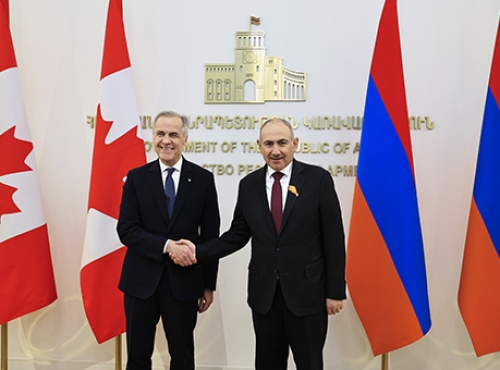
Canada is ready to support Armenia in conducting elections, Prime Minister Mark Carney said during a meeting with Armenian Prime Minister Nikol Pashinyan in Yerevan.
Pashinyan welcomed Carney and his delegation’s visit within the framework of the 8th European Political Community summit.
“I would like to thank you for accepting the invitation to participate in the European Political Community summit and for taking the opportunity to visit our country. I believe your participation makes this format more effective, as it clearly broadens perspectives and viewpoints,” the Armenian prime minister said.
Mark Carney thanked the Armenian government for the invitation and expressed gratitude for the assistance provided to Canadians in connection with the Iran conflict. He also referred to ongoing monitoring efforts in the region carried out in cooperation with the European Union, noting his impression of Pashinyan’s leadership in promoting regional stability and prosperity for the Armenian people.
The sides discussed Armenia–Canada bilateral relations and exchanged views on issues of mutual interest.
At the same time, the European Union has sent a group of experts to Armenia specializing in countering Russian propaganda and interference, “expanding its support to the former Soviet republic during a period of political tension,” according to The Guardian.
The report notes that EU leaders held their first summit with Armenia in Yerevan following a broader European Political Community gathering of around 45 leaders.
It also states that the EU has deepened ties with Armenia as Russia’s influence has declined following its full-scale invasion of Ukraine, which diverted Moscow’s attention from other countries it considers part of its “near abroad”.
The EU has established a team of 20–30 civilian experts for a two-year mission in Armenia aimed at improving responses to cyberattacks, information manipulation, and interference, as well as countering illicit financial flows. The mission is expected to begin work after the June 7 parliamentary elections.
Separately, the EU’s external service announced a “rapid hybrid response team” tasked with countering external interference ahead of the elections, which are seen as crucial in determining whether Armenia remains broadly on a pro-Western path.
EU foreign policy chief Kaja Kallas said last month: “Armenians are facing massive disinformation campaigns and cyberattacks. When Armenians go to the polls in June, only they should decide their country’s future”.
An EU official described the EU–Armenia summit as “an important milestone” and a symbol that Armenia is gradually reorienting toward the West. The EU is also working to improve transport links and support Armenia’s green transition, while launching talks that could eventually allow visa-free short-term travel for Armenians.
Armenia, long considered Russia’s closest ally in the Caucasus, has grown disillusioned after Moscow did not provide military assistance during the 2020 and 2023 Nagorno-Karabakh conflicts.
Despite efforts to move closer to the EU, Armenia remains under significant Russian pressure. Russia continues to be a key trade and security partner, maintains a military base in Gyumri, and has imposed restrictions on Armenian exports such as mineral water and brandy. Russian President Vladimir Putin has also warned that cheap gas supplies could be at risk if Armenia deepens integration with Europe.
Members of the European Parliament last week urged the EU to go beyond symbolic support, calling for strong international election monitoring, cybersecurity for electoral infrastructure, and safeguards against vote-buying.
French MEP Nathalie Loiseau, who contributed to the resolution, said: “Against all those trying to pressure Armenian voters, the country is turning to the European Union for help in holding free and fair elections”.
Parliamentary elections in Armenia are scheduled for June 7, 2026.