












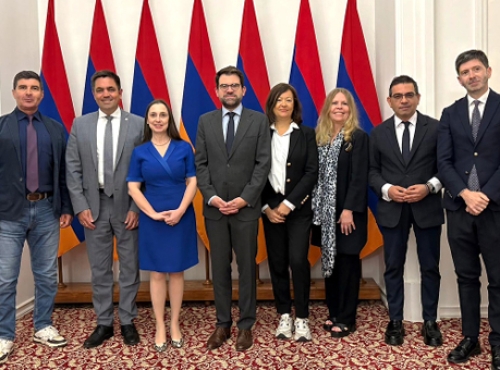
Following a two-day visit to Yerevan on May 11-12, a delegation from the Parliamentary Assembly of the Council of Europe said Armenia’s June 7, 2026, parliamentary elections must be held in an environment free from fear, undue external influence, and abuse of administrative resources.
The delegation expressed concern over what it described as a more complex and systemic nature of foreign interference affecting Armenia’s political and information space. According to the statement, external interference has moved beyond traditional disinformation and now includes illicit political financing, cyberattacks, economic pressure, and direct attempts to manipulate the electoral process. The aim of such hybrid tactics, the delegation said, is not only to influence public opinion but also to secure long-term geopolitical leverage over Armenia, Factor.am reported.
The delegation was also informed about direct requests allegedly made by the Russian president to Armenia’s prime minister to facilitate voting by the Armenian diaspora living in Russia, as well as about financial incentives reportedly offered by the main opposition party to members of that diaspora to travel to Armenia and participate in election day voting.
PACE delegates stressed that such interference represents an ongoing threat extending far beyond the election period itself. At the same time, they also noted declarative support shown by certain Western partners toward the ruling political force.
The delegation positively assessed Armenia’s legal and regulatory mechanisms aimed at countering such influence, but emphasized the urgent need to strengthen institutional capacities, improve interagency coordination, and increase transparency in political financing.
It was also noted that the delegation was concerned by intensified disinformation targeting human rights defenders, journalists, and civil society representatives. Accusations of being “foreign agents,” according to the delegation, undermine public trust and restrict civic space.
The delegation also received information about the systematic spread of false and manipulative content on social media, as well as legal pressure against journalists, civil society actors, and election observers, including the use of SLAPP lawsuits. According to the delegation, such practices could harm freedom of speech and hinder democratic participation.
Among other concerns raised were growing political polarization, low public trust in state institutions, and a lack of political engagement, especially among young people. The delegation also heard allegations regarding abuse of administrative resources, pressure on voters, unregulated third-party campaigning, and vote-buying sometimes presented as charity.
PACE also pointed to what it described as the unprecedented involvement of the Armenian Apostolic Church in political processes and stressed the importance of transparency and accountability in campaign financing, especially in light of recent legislative changes.
During the visit, the delegation met with the vice speaker of parliament, representatives of parliamentary and extra-parliamentary political forces, members of the Central Election Commission, heads of state agencies, representatives of international organizations, as well as civil society and media representatives. The delegation highly praised the Central Election Commission’s efforts to improve cybersecurity.
Ahead of the elections, the PACE delegation called on Armenian authorities to strengthen safeguards against external interference and ensure equal conditions for all political actors.
PACE will deploy a full-scale observation mission to monitor the June 7, 2026, elections jointly with observers from the OSCE Office for Democratic Institutions and Human Rights, the OSCE Parliamentary Assembly, and the European Parliament.