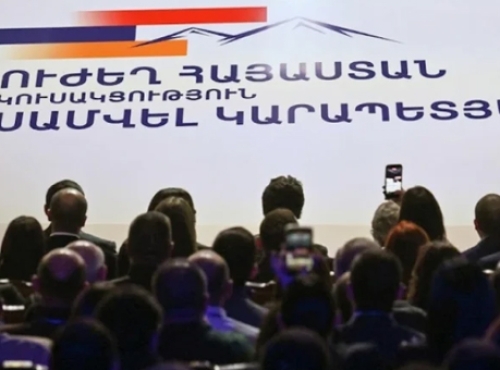














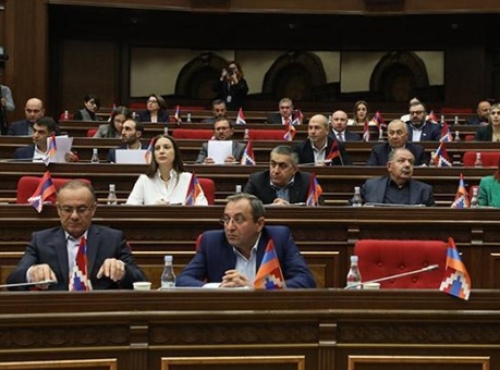
The National Assembly’s Hayastan faction described the PACE pre-election delegation’s interim assessments as one-sided and unfounded.
The statement said that “non-specific” assessments contribute to the formation of an atmosphere of impunity.
The faction noted that it values several assessments and emphases included in the document and positively assessed meetings held with opposition representatives. At the same time, it said it was necessary to draw attention to issues which, according to the opposition, remained outside the scope of the observers’ evaluations.
The faction argued that claims suggesting “constructive cooperation between Armenia’s authorities and stakeholders” ahead of the elections were groundless, asserting that opposition forces had faced criminal prosecution, political targeting, hate speech and other forms of pressure.
The authors of the statement also stressed that the presented assessments were overly general and superficial, without taking into account what they described as the systemic nature of the problems. According to the faction, the issue concerns not isolated incidents or political tensions, but a consistent government policy involving administrative control, institutional pressure, selective justice and political persecution.
The faction further stated that an effective equivalence had been drawn between the authorities and the opposition, despite the opposition’s claims that the state system, administrative resources, law enforcement bodies and a significant part of the information sphere remain under government control.
“Non-specific assessments do not restrain but rather further encourage the current authorities, creating an atmosphere of international tolerance and impunity, which at this stage does not contribute to the implementation of the principle of democratic elections,” the statement said.
The statement also expressed bewilderment that several opposition concerns were presented merely as “heard” information, while the authorities’ positions were reflected as established facts.
The Hayastan faction added that the PACE statement failed to reflect a number of concerns they had raised regarding what they described as deepening authoritarian tendencies in Armenia, judicial dependence, amendments to the electoral code, the use of administrative resources, media inequality and pressure against political opponents.
The faction also described as unfounded and unbalanced the section of the statement referring to the “unprecedented involvement of the Armenian Apostolic Church” in politics. According to the opposition, a balanced approach should also have addressed actions directed against the Church and the Catholicos.
“We hope that the PACE observer mission, while pursuing the fundamental democratic value of forming власти through free expression of will, will base its future observations on deeper, evidence-based and comprehensive analysis,” the statement said.
The PACE delegation expressed concern over what it described as the increasingly complex and systemic nature of foreign interference affecting Armenia’s political and information sphere. The delegation was also informed about direct requests by the Russian president to Armenia’s prime minister aimed at facilitating voting by the Armenian diaspora living in Russia, as well as alleged financial incentives offered by the main opposition party to members of that diaspora to travel to Armenia and participate in election day voting.
The PACE delegation also noted what it called the unprecedented involvement of the Armenian Apostolic Church in political processes and stressed the importance of transparency and accountability in campaign financing, particularly in light of recent legislative amendments.