













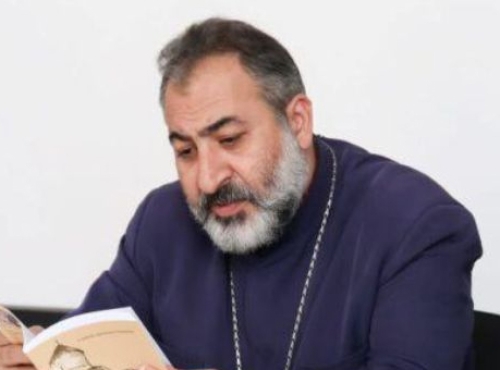
Public statements made by the Armenian Apostolic Church cannot in themselves be considered political interference, said Archimandrite Fr. Isahak Poghosyan, acting primate of the Gegharkunik Diocese, responding to the May 13 interim statement by the PACE pre-election delegation referring to the “unprecedented involvement of the Armenian Apostolic Church in politics.”
“The above wording requires examination in light of both international legal standards and the fundamental principles governing relations between religion and the state in democratic societies.
The assessment voiced regarding the Armenian Apostolic Church raises concern not only because of its content, but also because such a serious and publicly influential characterization has been presented without sufficient factual substantiation or clear criteria.
It should be noted that Articles 9 and 10 of the European Convention on Human Rights guarantee both freedom of religion and conscience, as well as freedom of expression. In this context, public statements by a religious institution cannot in themselves be regarded as political interference unless there is clear and substantiated evidence of direct, organized or unlawful influence on electoral processes,” the statement said.
It further stated that in a democratic state, religious institutions — especially those with deep historical and cultural roots — are not limited solely to ritual or internal community functions. For centuries, the Armenian Apostolic Church has served not only as a center of faith, but also as a key pillar of spiritual resilience, national identity and moral consciousness.
According to the statement, the Church’s participation in public discourse, particularly on issues of national or moral significance, should not automatically be interpreted as political involvement, but rather as an expression of freedom of conscience and expression protected by the same international legal system under which observer missions operate. The Church, as a bearer of historical memory, moral consciousness and spiritual identity, cannot be deprived of its natural right to speak on matters of public importance.
“At the same time, from the standpoint of legal standards, any assessment concerning ‘political involvement’ must be based on the principles of proportionality, necessity and sufficient factual basis, in accordance with the criteria applied in democratic societies for justifying interference. Without such clarification, such characterizations may be perceived merely as value judgments rather than legally verifiable conclusions.
It is also noteworthy that the mandate of international observation missions is limited to the impartial assessment of electoral processes from the standpoint of ensuring freedom, fairness and competitive equality. Value-based characterizations made beyond that mandate may affect not only public perception, but also the institutional credibility of observation missions.
By its very nature, the Armenian Apostolic Holy Church does not seek political power or institutional control. Its mission is spiritual, aimed at preserving inner freedom, moral responsibility and social solidarity. In this context, the Church’s voice in public life should be viewed as an expression of spiritual consciousness capable of coexisting with political pluralism in a democratic society without replacing or appropriating it,” the statement said.
The statement also described it as concerning that the assessment appeared selective and lacked equivalent reference to other influential actors operating in the public sphere, which, according to the diocese, may create the impression that the issue is being approached not through universal democratic standards but through selective treatment.
“The stability of democracy depends not only on the balance of political institutions, but also on the value system upon which social cohesion is built. Within that framework, the role of spiritual institutions should be recognized and responsibly understood rather than restricted.
Therefore, democracy is fully realized only where not only political pluralism is protected, but also the spiritual identity and freedom of conscience of the people,” emphasized Archimandrite Fr. Isahak Poghosyan, acting primate of the Gegharkunik Diocese of the Armenian Apostolic Church.
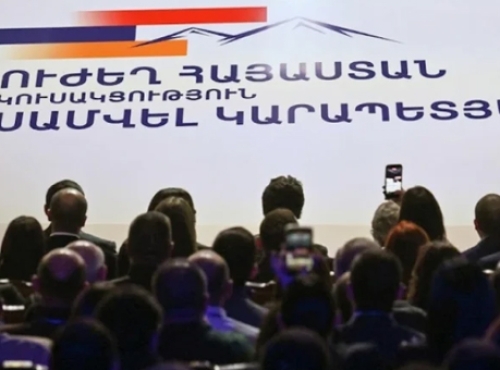
The issue was also addressed by the Hayastan alliance, which stated that a balanced PACE response “should also have referred to unconstitutional actions and repression directed against the Armenian Apostolic Church and its leader, the Supreme Patriarch, including the unlawful commitment included in the Civil Contract election platform to force the Catholicos to resign.”