









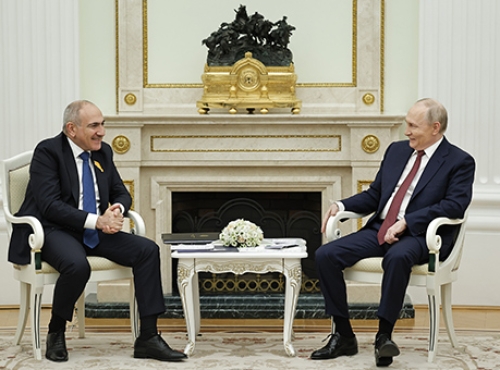
A phone conversation between Russian President Vladimir Putin and Armenian Prime Minister Nikol Pashinyan has sparked fresh discussion. Putin called Pashinyan shortly before the parliamentary elections and congratulated him on his birthday. However, Russian government circles believe that the call from the Kremlin “does not mean that Moscow has softened its position regarding Armenia’s choice between the European Union and the Eurasian Economic Union (EAEU),” Kommersant reported, citing a source.
According to the newspaper’s interlocutor in Russian government circles, the latest call from the Kremlin to Yerevan in no way indicates a revision of Russia’s position on Armenia’s decisive choice between the EU and the EAEU. The source said Moscow continues to insist on the need to put EAEU membership to a nationwide referendum.
The author of the article titled “The Last Call” recalled that Kremlin spokesman Dmitry Peskov had described the conversation as “a good opportunity” to continue discussions on future relations with Armenia following the meeting of the Supreme Eurasian Economic Council in Astana.
The Kremlin press service reported the June 1 telephone conversation between Vladimir Putin and Nikol Pashinyan. A brief statement published on the Kremlin website said that the Russian president called Yerevan to congratulate his Armenian counterpart on his birthday. Nikol Pashinyan turned 51 on June 1. In addition, the Russian leader sent a congratulatory telegram to Armenia’s prime minister.
“Relations between our countries and peoples have traditionally been friendly in nature. I would like to wish you health, prosperity, and success,” the Russian president said in his message to Nikol Pashinyan.
Details of the conversation were later provided to journalists by Dmitry Peskov. According to him, the exchange was the first direct communication between the two leaders since Pashinyan’s visit to Moscow on April 1. During the discussion, they addressed all issues related to Armenia’s membership in the Eurasian Economic Union, including the statement adopted by four leaders of the bloc during last week’s summit in Kazakhstan.
“There was a continuation of discussions on the agenda that had been considered at the meeting of the Supreme Eurasian Economic Commission in Astana,” Dmitry Peskov said.
According to the article, the main political outcome of the multilateral discussions was that Moscow’s position regarding Armenia was also supported by the leaders of Belarus, Kazakhstan, and Kyrgyzstan. In their joint statement, Russia and its partners raised, for the first time in the 12-year history of the EAEU, the issue of Armenia’s future foreign policy choice and suggested that the cost of that choice could be the loss of membership in the organization.
The first official reaction in Yerevan to the Putin-Pashinyan conversation came from Armenian Economy Minister Gevorg Papoyan, who did not hide his satisfaction. Speaking to reporters during the campaign ahead of the June 7 parliamentary elections, the close ally of the prime minister argued that existing problems in relations with Moscow were exaggerated and artificially inflated by the media.
“I know that there was a very warm conversation between Prime Minister Pashinyan and President Putin. I believe all these issues have been exaggerated by the Armenian media, and they will all be resolved,” the minister said.
At the same time, Gevorg Papoyan did not answer a follow-up question on whether Yerevan had prepared a response to a letter received from Moscow regarding the possible cancellation of agreements on preferential supplies of gas, petroleum products, and natural diamonds.
According to the article’s author, it is noteworthy that Dmitry Medvedev, Deputy Chairman of Russia’s Security Council, also sent a congratulatory message to Nikol Pashinyan. His remarks likewise indicated that Moscow’s position remains firm.
“Comrade Nikol is walking along Comrade Trotsky’s dangerous path. Responding to calls for a referendum on which integration bloc Armenia should belong to, he used Lev Davidovich’s famous formula: ‘Neither war nor peace, and disband the army.’ In practice, it sounds like this: we will not decide anything through a referendum until we are invited to the EU. Then, naturally, we will run toward Europe. But until then, we will continue enjoying all the benefits of the EAEU while skillfully earning income from Russia and the other member states,” Dmitry Medvedev wrote on his channel on the Max platform.
In this context, he stressed that Armenia’s prime minister is “certainly a good politician,” but recalled that “the sought-after formula ultimately led to the Brest peace treaty being signed anyway, only on worse terms.”
“And Trotsky’s winding path ended rather tragically for him,” Medvedev concluded in the closing lines of his congratulatory message.
At a meeting of the Supreme Eurasian Economic Council held in Astana on May 29, the presidents of four EAEU member states—Russia, Kazakhstan, Belarus, and Kyrgyzstan—adopted a statement regarding Armenia’s situation. Armenia was urged to hold a referendum as soon as possible on choosing between the EAEU and the European Union.
In recent days, several Russian officials have also stated that if Armenia continues moving toward the European Union, it could lose access to Russian gas supplied on preferential terms.
Russia has additionally imposed restrictions on imports of Armenian products. These measures include bans on the import of Jermuk mineral water, flowers, and certain alcoholic beverages, as well as restrictions on agricultural products such as tomatoes, cucumbers, and strawberries.