












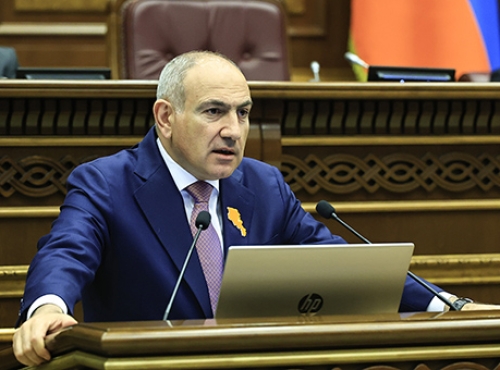
Prime Minister Nikol Pashinyan said restrictions currently imposed on Armenian agricultural products are a mistake because they “turn people against the Eurasian Economic Union (EAEU).” He made the remarks in Tsovagyugh while answering a question from a correspondent of Russia’s Izvestia newspaper.
He also said he had a positive telephone conversation with Russian President Vladimir Putin, according to Factor.am .
“As a senior official within the EAEU, I consider this a problem. Phytosanitary inspections involving individual companies can create such issues, and this happens everywhere, including in Russia and Belarus. But overall, we have very good products, and we are continuously improving the quality of our sanitary oversight.
Yesterday I spoke with the President of Russia and thanked him for the call. He had called to congratulate me on my birthday. We also discussed current affairs, and we had a positive conversation. I believe the best step in this context would be simply to abandon all kinds of restrictions. As for phytosanitary matters, they are a normal phenomenon, have always existed and should continue to exist. But at the moment this issue is being politicized, and I fear it may create certain negative sentiments in the Republic of Armenia toward the Eurasian Economic Union,” he said.
During a pre-election meeting in the village of Lchashen in Gegharkunik Province, Pashinyan addressed the new restrictions affecting exports of Armenian products to Russia. He said companies should continue working to improve product quality and that in cases of unfair treatment, the government would provide support and implement subsidy programs, according to Panorama.am.
“The saying that there is no bad without some good applies here,” Pashinyan said, adding that relevant processes had already begun, business delegations had traveled abroad, and the government would soon present proposals related to exports of roses, fruits and vegetables.
He noted that Armenia’s production volumes are relatively small and that even a single major European supermarket chain could purchase the country’s entire output.
“Our production is not very large. One major European supermarket chain could buy all of it,” the prime minister said.
Pashinyan also explained that instead of exporting 90 tons out of 100 tons of peppers to a single destination, exports should be distributed across several markets—initially four and later seven destinations—to ensure export diversification.
“If you depend 90% on one place, one morning people may wake up in a different mood. If peppers spoil, I will pay for those peppers, the government will pay. If it is roses, we will pay for them too. But as a result of all this, exports of peppers will increase, and so will exports of roses,” he said.
The prime minister also noted that the number of tourists has increased and that visitors purchase various Armenian products, including peppers, roses and brandy, while also using other services.
“Many people were talking about market prices. I hope fruit and vegetable prices in Armenia will decrease somewhat, but in a way that does not harm producers,” he said.
He also stressed the need to consider restoring the northern railway, noting that the shortest east-west route passes through Armenia’s northern regions, including Ijevan, Lori and Gyumri.
“We need to think about restoring the northern railway. It turns out that the shortest route from east to west passes through northern Armenia—through Ijevan, Lori and Gyumri,” he said.
Pashinyan assured those gathered that the TRIPP route would include a gas pipeline, oil pipeline, railway and high-voltage transmission lines.