












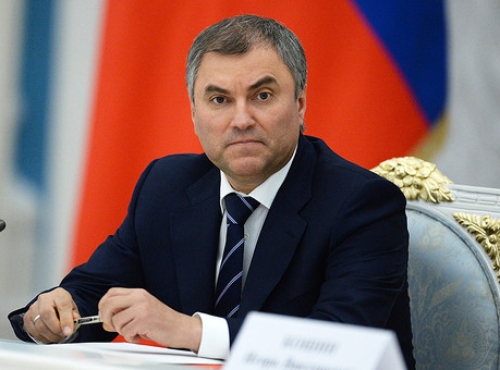
Russian State Duma Chairman Vyacheslav Volodin has accused Armenian Prime Minister Nikol Pashinyan of “using the EAEU to move toward the EU” and attempting to solve Armenia’s problems at the expense of the Eurasian Economic Union and, above all, Russia. He made the remarks in response to Pashinyan’s statement about compensating farmers affected by Russian import restrictions.
Volodin added that a similar situation had occurred in Ukraine, where promises of development accompanied European integration efforts, but, according to him, European markets ultimately did not open to Ukrainian products, RBC reported.
He further claimed that Pashinyan is not fully informing Armenian citizens about the process of joining the European Union and is “concealing the possible consequences of leaving the EAEU.”
According to Volodin, those consequences could include an almost fourfold increase in gas prices for consumers, a sharp decline in money transfers from Russia to Armenia—which he said amount to around $4 billion annually and account for roughly two-thirds of all remittances—as well as the loss of migration privileges. He argued that Armenians seeking employment in Russia would then have to rely solely on the patent-based work permit system.
Volodin also stated that supplies from Armenia to Russia could be halted, including flowers, berries, fruits, vegetables, peppers, fish products, alcoholic beverages and mineral water.
“The same thing happened in Ukraine. When decisions were made regarding integration with the European Union, one set of promises was made, including those related to development prospects. In reality, Ukrainian agricultural products were effectively not allowed to enter European markets, as strict and unfavorable tariff quotas were introduced. The same awaits Armenia,” Volodin said.
He also expressed the view that Pashinyan may have taken on personal commitments regarding Armenia’s European integration and is trying to shift the costs of that process onto the EAEU and Russia.
“It is obvious that he is not concerned about the fate of the Armenian people or Armenian statehood. In this case, he believes that this is how he will preserve his personal power,” the State Duma chairman concluded.
Pashinyan previously promised compensation to farmers who suffer losses as a result of restrictions on exports to Russia. During a pre-election meeting in Gegharkunik Province, he stated that state support would be directed toward offsetting losses. At the same time, the prime minister acknowledged that in some cases Armenian products had failed to meet required quality standards, adding that such companies would also receive assistance aimed at improving product quality.
In recent days, several Russian officials have stated that if Armenia continues moving toward the European Union, it could lose access to Russian gas under preferential terms.
Russia has also imposed restrictions on imports of Armenian products. Imports of Jermuk mineral water, flowers and certain alcoholic beverages have been banned. Restrictions have additionally been applied to a number of agricultural products, including tomatoes, cucumbers and strawberries. Since June 2, Russia has restricted imports of cherries, apricots, peaches, plums, grapes and other stone fruits from Armenia, as well as their transit to other EAEU member states.