










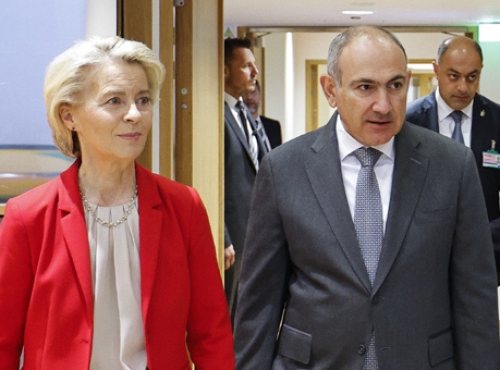
European Commission President Ursula von der Leyen and Armenian Prime Minister Nikol Pashinyan are expected to hold a phone conversation on June 3 to discuss possible European Union support for Armenia in response to economic restrictions imposed by Russia, RFE/RL reported, citing sources in Brussels.
According to the report, the EU is preparing a financial assistance package for Armenia, although the final amount has not yet been determined.
In addition to direct financial support, Brussels is reportedly considering granting Armenia preferential trade conditions through Autonomous Trade Measures (ATM). Under this mechanism, selected Armenian products could gain access to the European market without customs duties or quota restrictions.
The specific goods that could benefit from the arrangement have not yet been identified. The EU typically uses this instrument to support partner countries facing economic challenges and to strengthen their integration with the European market.
The most recent example is Ukraine, which received Autonomous Trade Measures in June 2022, several months after Russia’s full-scale invasion.
Moldova has benefited from the mechanism since 2008, and the EU expanded those preferences in 2014 after Russia banned imports of Moldovan wine, fruit and meat products.
Armenia began discussions with Brussels on a possible preferential trade regime several years ago.
“The negotiations are not progressing easily,” Economy Minister Gevorg Papoyan said in 2024.
According to RFE/RL's sources, however, the European Commission is now prepared to move forward with the initiative.
The proposed trade preferences would be unilateral, meaning Armenia would not be required to offer the same treatment to European goods. This would allow Yerevan to avoid potential conflicts with its obligations within the Eurasian Economic Union (EAEU).
Earlier, Armenian Foreign Minister Ararat Mirzoyan and EU Commissioner for Enlargement Marta Kos held a phone conversation. Following the call, Kos wrote on X that Brussels stands in solidarity with Armenia in the face of growing economic pressure from Russia and is seeking rapid response measures.
“We will accelerate efforts to strengthen trade and energy connections toward and within the South Caucasus, while supporting Armenia’s economic links with its immediate neighbors,” the commissioner said, adding that Armenia is a sovereign and independent country whose people are free to choose their own path.
If the EU ultimately approves Autonomous Trade Measures for Armenia, Armenian producers could gain preferential access to a European market of roughly 450 million consumers, provided their products meet EU standards and quality requirements.
Russia has recently imposed restrictions on a range of Armenian exports. These include bans on imports of Jermuk mineral water, flowers and certain alcoholic beverages. Restrictions have also affected agricultural products such as tomatoes, cucumbers and strawberries. Since June 2, Russia has limited imports and transit of Armenian cherries, apricots, peaches, plums, grapes and other stone fruits to EAEU member states. Beginning June 3, additional restrictions were introduced on imports of Armenian eggplants, potatoes and dried fruits.